The Ultimate Guide to Financial Independence (FIRE) for Families
Some posts contain affiliate links, see disclosure for more details.
If you’ve ever wished you had a bit more breathing room financially, you’re not alone. Lots of families feel as though their budget is permanently tied to their monthly income, with very little margin for change.
When most of your income disappears into the same bills every month, it’s easy to feel like there’s very little room to move.
The idea behind financial independence is gradually building that margin over time.
For most families, money shapes a lot of the decisions we make.
- How many hours we work.
- Whether one parent can reduce their income.
- How comfortable we feel when an unexpected bill appears.
- How much flexibility we actually have.
Financial Independence, often shortened to FIRE, is really about gradually changing that reality.
Not by trying to become extremely wealthy.
Not by retiring at 35.
But by gradually building enough financial security that work becomes something you choose to do, not something you absolutely have to do.
For some families, that might mean stepping away from full-time work earlier than expected. For others, it simply means having the freedom to reduce hours, change careers, or cope with a job loss without immediate panic.
At its heart, financial independence isn’t really about escaping life. It’s about giving your family a bit more breathing room.

What Financial Independence Really Means
FIRE stands for Financial Independence, Retire Early. The name makes it sound quite dramatic, but most families who follow this approach aren’t actually planning to stop working in their thirties.
Financial independence simply means having enough savings and investments to cover your essential living costs if you needed them to.
You might still choose to work. In fact, many people do. The difference is that your whole life no longer depends on one monthly salary.
For families, that often shows up in practical ways, like:
- The option to reduce working hours.
- More flexibility around school holidays.
- The freedom to change jobs without panic.
- More resilience if one income drops.
Retiring early is one possible outcome, but it’s not the only goal.
For many families, the real milestone is simply becoming mortgage-free.
It lowers monthly pressure and makes the numbers behind financial independence much easier to reach.
How FIRE Works in Practice
The basic idea is actually quite simple.
Spend less than you earn.
Save the difference.
Invest it regularly.
Then give it time to grow.
In theory it’s simple.
In practice it takes patience, steady habits, and sometimes choosing long-term security over short-term upgrades.
Some people pursuing FIRE aim to save 40 or 50 percent of their income. For a lot of families, that’s neither realistic nor necessary.
Between childcare, housing costs and everyday life, most families simply don’t have that much room in their budget. School trips, growing kids, and everyday surprises all add up faster than we expect.
What matters most is consistency.
Even a steady 15 or 20 percent savings rate, maintained over time, can make a huge difference.
The Maths Behind Financial Independence
Most FIRE calculations are based on two widely used guidelines: the 25 times rule and the 4 percent rule.
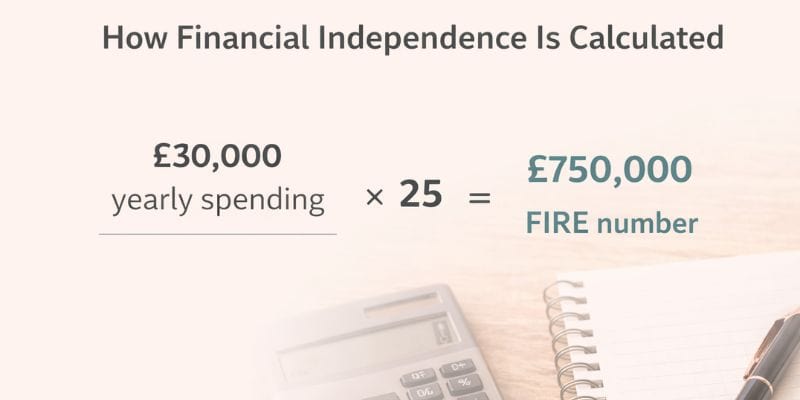
The 25 times rule suggests you need roughly 25 times your annual spending invested to reach financial independence.
If your household spends £30,000 per year, that would suggest a target of around £750,000.
The 4 percent rule comes from historical market research which found that withdrawing around 4 percent of a diversified portfolio each year has, in the past, supported a 30-year retirement.
Many UK investors choose to be slightly more cautious and use 3 to 3.5 percent as a planning assumption, particularly if retiring early or wanting additional safety.
These figures are not guarantees. They are starting points for thinking about what level of investment might support your lifestyle.
Try our FIRE calculator to get an idea of your own ‘FIRE number’.
Spending plays a central role here. The lower your ongoing costs, the lower your required portfolio.
This is why frugal families often make faster progress toward financial independence, even on moderate incomes.
What Financial Independence Looks Like in the UK
Much of the conversation around FIRE started in the United States, so many examples you’ll see online are based on US tax rules and retirement accounts.
For UK families, the structure looks slightly different.
The basic idea stays the same.
You gradually build investments that can eventually support your spending. But the accounts you use, the ages you can access them, and the role of state support all influence how you plan.
ISAs and Tax Efficiency
In the UK, Individual Savings Accounts, or ISAs, are one of the most powerful tools for building financial independence.
Money invested inside a Stocks and Shares ISA can grow free from capital gains tax and dividend tax. Withdrawals are also tax free.
This makes ISAs particularly useful for anyone hoping to access investments before pension age, as there are no age restrictions on withdrawals.
For families aiming to reduce work in their forties or early fifties, ISAs often play a central role.
Some households also use a Lifetime ISA. These offer a government bonus on contributions, which can be helpful for first-time buyers or retirement savings. However, withdrawals are restricted until age 60 unless used for a first home, so they tend to work best as part of a longer-term retirement strategy rather than for early access.
Pensions and Access Age
Pensions are extremely tax efficient in the UK. Contributions receive tax relief, and employers often add matching contributions.
However, pensions cannot currently be accessed until your late fifties, with the minimum pension age set to rise over time.
This creates what many people call a “bridge period”. If you plan to stop full-time work before pension access age, you will need enough accessible investments, such as ISAs, to cover the gap.
For some families, this simply means building a combination of pension wealth for later life and ISA investments for earlier flexibility.
The State Pension
The UK State Pension also plays a role in long-term planning.
While it is unlikely to fully cover most households’ desired lifestyle, it can reduce the amount of private investment required later in life.
For example, if you expect to receive the full State Pension, you may not need your investments to cover your entire spending level indefinitely. This can lower the overall portfolio target for those retiring closer to traditional pension age.
Housing and Mortgages

Housing costs are often the largest expense for UK families.
It’s not unusual for the mortgage payment alone to take the bulk of the entire monthly budget. For a lot of families the mortgage or rent payment shapes almost every other financial decision they make.
Paying down or clearing a mortgage can significantly reduce the amount of annual spending that needs to be replaced by investments.
For many families, becoming mortgage-free is a major milestone on the path to financial independence. It lowers financial pressure and reduces the size of the required investment portfolio.
A Balanced Approach
Financial independence in the UK is rarely about one single account or one perfect withdrawal rate.
It is about building a mix of:
- Accessible investments for flexibility
- Pension wealth for later security
- A manageable cost of living
- And a plan that adapts as your family grows and changes
The numbers matter, but the structure matters too.
Understanding how UK tax rules and pension access work allows you to design a path that fits your timeline, rather than copying an approach designed for a different system.
Different Types of FIRE
Financial independence is not one rigid formula. Over time, different approaches have emerged to suit different lifestyles, incomes, and priorities.
For families, the key is not choosing the most extreme version, but choosing the one that fits your values and stage of life.
Lean FIRE
Lean FIRE focuses on reaching financial independence with a relatively low annual spending level.
Because the target number is based on your expenses, keeping those expenses modest reduces the size of the investment portfolio required.
For a family, this might mean:
Living in a lower-cost area
Owning a smaller home
Keeping cars for longer
Prioritising experiences over upgrades
Being intentional about recurring costs
Lean FIRE can work well for families who genuinely value simplicity and are comfortable maintaining a lower baseline lifestyle.
However, it requires realism. Children’s costs change over time. Activities, travel, and social expectations can increase spending. Building in a margin of safety is especially important if relying on a smaller portfolio.
For some households, Lean FIRE feels freeing. For others, it may feel restrictive. It is less about extreme minimalism and more about aligning spending with what truly matters.
Coast FIRE
Coast FIRE is often appealing to parents.
The idea is to invest heavily in earlier years. Once your portfolio is large enough that it should grow to support retirement at a traditional age, you can reduce or stop further retirement contributions.
You continue working to cover your current expenses, but you are no longer racing to build your pension.
For families, this can mean:
Reducing pressure to climb the career ladder
Moving to part-time work
Choosing roles with better flexibility
Prioritising school holidays and family time
Coast FIRE does not usually mean stopping work entirely. Instead, it removes the urgency.

Barista FIRE
Barista FIRE sits somewhere between full financial independence and traditional employment.
Your investments cover most of your expenses, but you continue working part-time or in a lower-pressure role to top up your income.
For parents, this can create breathing room without fully stepping away from the workforce.
It can allow:
Shorter working weeks
Flexible or term-time roles
Self-employment on a smaller scale
Career changes without financial panic
Barista FIRE acknowledges that many people do not want to stop working completely. They simply want greater control over how and when they work.
Fat FIRE
You may also come across the term Fat FIRE.
This refers to reaching financial independence while maintaining a higher level of annual spending, often requiring a significantly larger investment portfolio.
For higher earners or those with substantial assets, this approach may feel realistic. For many average UK families, it is less relevant.
It is worth understanding as part of the broader conversation, but for most households, financial independence is more about stability and flexibility than maintaining an expansive lifestyle without working.
Is Financial Independence Possible on an Average Income?
When people first discover FIRE, the numbers can feel a bit overwhelming.
You’ll often see targets like £600,000 or £800,000 mentioned online, which can make it sound as though financial independence is only realistic for very high earners.
In reality, the journey depends far more on spending levels, consistency, and time than on having an exceptional salary.
A Realistic Example
Imagine a household earning £55,000 per year before tax.
After tax and pension contributions, their take-home income might sit somewhere around £3,400 to £3,700 per month, depending on circumstances.
If that family manages to live on £2,800 per month and consistently invests £600 to £800 per month, they are not saving 50 percent of their income. They are saving steadily.
Over time, with investment growth, those monthly contributions compound.
At an average annual return of 5 to 7 percent after inflation, consistent investing over 20 years can build a substantial portfolio.
Would this lead to retirement at 40? Probably not.
Could it lead to meaningful flexibility by the early or mid-fifties? Quite possibly.
And along the way, the household benefits from:
A growing emergency buffer
Reduced reliance on credit
A rising net worth
More confidence in career decisions
Financial independence doesn’t happen overnight. It builds gradually over time.
Read more: Can you reach FIRE on a low income?
The Role of Spending
How much you spend plays a big role in how quickly financial independence becomes possible.
A family spending £40,000 per year will need a much larger investment portfolio than one spending £28,000 per year.
This is where frugal living becomes more than just saving money. Lower recurring expenses reduce the size of the target itself.
The goal isn’t to deprive yourself. It’s simply to spend in a way that supports the life you actually want.
FI-Lite and Milestones

For many families, full early retirement is not the first milestone.
Instead, the journey might look like:
- Six months of expenses saved
- One year of expenses invested
- Becoming mortgage-free
- Reaching Coast FIRE
- Building enough investments to cover essential bills
Each of these steps reduces financial stress before full financial independence is reached.
That shift in security often matters more than the headline retirement date.
The Trade-Offs and Risks of Pursuing FIRE
Financial independence can be powerful. But it isn’t risk-free, and it isn’t just about maths.
A balanced view matters, especially when you’re making decisions that affect your whole family.
Investment Risk
Most FIRE plans rely on long-term stock market growth.
Markets don’t move in straight lines. There will be years of strong growth, and there will be years that feel uncomfortable. If you’re withdrawing money during a downturn, timing can make a difference.
That’s one reason many families prefer to plan around a slightly lower withdrawal rate, such as 3 to 3.5 percent, rather than leaning fully on 4 percent.
Building flexibility into your plan can help. That might mean keeping a cash buffer, being open to part-time work, or being willing to adjust spending if markets fall.
Financial independence works best when it includes room to adapt.
The Order of Returns Matters
Two people can earn the same average investment return over 30 years and still end up in very different positions.
If market drops happen early in retirement, they can have a larger impact than if they happen later.
You don’t need to fear this, but it’s worth understanding. A slightly larger safety margin can bring peace of mind.
Inflation and Rising Costs
Life rarely stays static.
Children grow. Activities start costing more. Energy bills creep up. Over time, inflation quietly pushes everyday costs higher.
Any long-term plan needs to allow for this. Using cautious assumptions and reviewing your numbers every few years helps keep things realistic.
Lifestyle Trade-Offs
Working towards FIRE usually means making deliberate choices about spending.
That might mean delaying certain upgrades, driving cars for longer, or choosing stability over status.
For some families, that feels freeing. For others, it can feel tight if taken too far.
The goal isn’t to squeeze joy out of life in the name of an earlier finish line. It’s to build security without creating new pressure.
Plans Change
Careers shift. Health changes. Family needs evolve.
A plan that suits you at 32 might look different at 42.
Financial independence isn’t about locking yourself into one rigid plan. It’s about building enough resilience that you can adjust when life inevitably changes.
How to Start Working Towards Financial Independence
You don’t need to overhaul your life to begin. In fact, the steadier your approach, the more likely you are to stick with it.
For most people, becoming financially independent is simply the result of consistent habits repeated over many years rather than one dramatic change.
In fact, the steadier your approach, the more likely you are to stick with it.
Here’s a practical starting point.
1. Understand Where You Stand

Before thinking about retirement ages or investment returns, look at your current position.
What do you own?
What do you owe?
How much do you spend each month?
Knowing your net worth and your true spending level gives you a baseline. Without that, the numbers are just guesses.
2. Stabilise Before You Optimise
If you don’t yet have an emergency fund, start there.
Three to six months of essential expenses in accessible savings provides breathing room. It also stops unexpected costs from derailing your progress.
Financial independence is built on stability, not speed.
3. Reduce the Big, Recurring Costs
You don’t need to cut every small pleasure.
Focus on the areas that shape most family budgets:
Housing
Transport
Food
Insurance
Subscriptions
Lower recurring expenses reduce the size of your FIRE target and free up money to invest.
4. Increase Income Gradually
For many families, increasing income moves the needle more than extreme frugality. Just a few hundred pounds of extra income each month can make a noticeable difference when it’s invested consistently.
That might mean:
- Seeking progression at work
- Upskilling
- Changing roles
- Adding a small side income
Even modest increases can grow significantly when they’re invested consistently.
Small changes often matter more than dramatic ones.
5. Invest Simply and Consistently
Many people pursuing financial independence use low-cost, diversified index funds.
The key isn’t complexity. It’s consistency.
In the UK, that often means using tax-efficient accounts such as ISAs and pensions, depending on your timeline and access needs.
Automating contributions removes the temptation to second-guess every market movement.
6. Review, Adjust, Continue
Financial independence isn’t a one-time calculation.
Life changes. Income changes. Spending changes.
Revisiting your numbers every year or two keeps your plan aligned with reality.
Progress doesn’t need to be dramatic. It needs to be steady.
You Don’t Have to Retire Early to Benefit

The phrase “retire early” gets most of the attention. It sounds dramatic and clear-cut.
But financial independence doesn’t have to end in full retirement to be worthwhile.
For some families, the goal genuinely is to step away from paid work decades before traditional retirement age. With careful planning and a sufficient margin of safety, that can be possible.
For others, the benefit shows up much earlier in the journey.
Having one year of expenses invested can change how secure you feel.
Reaching the point where your investments could cover essential bills reduces pressure.
Becoming mortgage-free lowers your monthly baseline dramatically.
These milestones don’t make headlines, but they shift your relationship with work and money.
Full financial independence might allow:
Leaving the workforce entirely
Working occasionally by choice
Pursuing projects that don’t prioritise income
Partial financial independence might allow:
Reducing hours
Changing careers
Taking extended breaks
Feeling less trapped by one salary
Both outcomes are valid.
Financial independence isn’t about perfection or extreme sacrifices. For most families, it’s simply about building a little more stability and flexibility over time.
Small changes, made consistently, can gradually give you more choice in how you work, spend your time, and support your family.
Frequently Asked Questions About FIRE in the UK
Yes, but the structure may look different from US examples.
UK investors often combine ISAs for accessible funds and pensions for later life. The State Pension can also reduce the amount you need to fund privately.
For many families, financial independence is gradual rather than extreme. The timeline depends on income, spending, and consistency.
A common starting point is 25 times your annual spending.
If you spend £30,000 per year, that suggests a portfolio of around £750,000.
Some families use a more cautious withdrawal rate than 4 percent, especially if retiring early, which may increase the target slightly.
Your personal number depends entirely on your spending, not your income.
Yes, but it usually requires time and steady habits rather than aggressive savings.
Moderate savings rates maintained over 15 to 25 years can build meaningful flexibility.
For many households, partial financial independence or Coast FIRE becomes achievable well before full early retirement.
No.
Some people pursue FIRE specifically to leave traditional employment early. Others simply want greater flexibility and reduced financial stress.
Financial independence gives you options. What you do with those options is personal.
Children increase expenses, but they don’t make financial independence impossible.
Higher spending simply changes the target number and the timeline.
Many families prioritise stability, flexible working, and reduced pressure rather than aiming for very early retirement.
The 4 percent rule is based on historical data, not a guarantee.
Some UK families plan using 3 to 3.5 percent to add a margin of safety, particularly if retiring well before pension age.
Regular reviews and flexibility are important.
Financial independence is about covering your expenses without relying on employment.
Wealth is relative. Some financially independent households live modestly. Others require larger portfolios.
The goal is security and choice, not necessarily luxury.
Timelines vary widely.
For those saving aggressively, it may take 10 to 15 years. For others, it may take 20 to 30 years.
Small, consistent progress still compounds over time.